
AI Agents are becoming a major trend that helps businesses automate workflows and improve operational efficiency. However, many people still confuse AI Agents with chatbots or AI content-generation tools. So, what is an AI Agent, how does it work, and in which fields can it be applied? This article from Ohtez will help you understand the concept, how it operates, its benefits, and suitable AI Agent implementation solutions for different businesses.
What is an AI Agent?
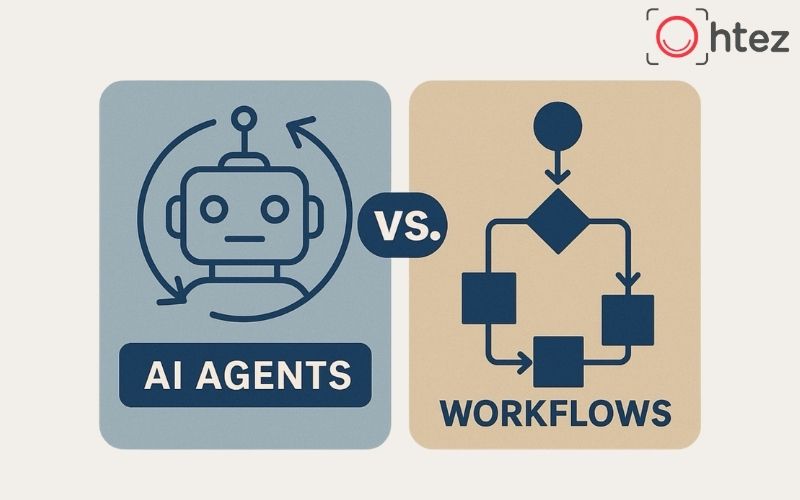
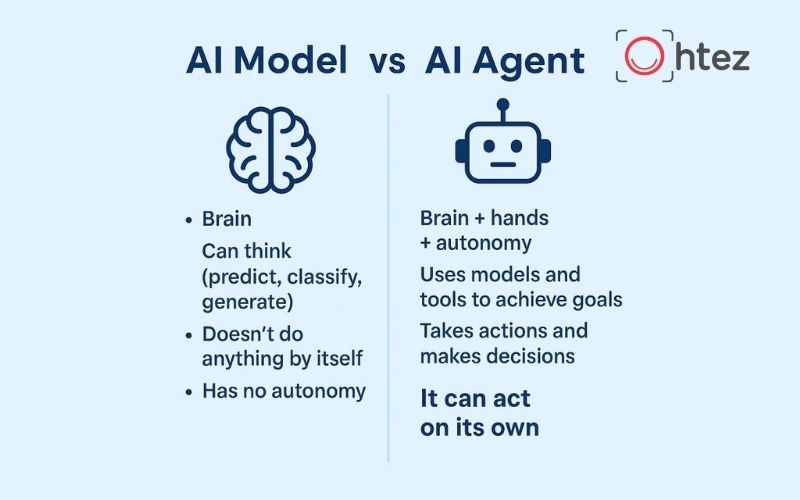
The question what is an AI Agent has attracted growing interest from businesses as artificial intelligence evolves from a response-generating tool into a system capable of taking proactive action. An AI Agent is software that can receive an objective, analyze data, create a plan, and perform tasks with a certain degree of autonomy. Unlike a chatbot that only responds to questions, an AI Agent can coordinate several consecutive steps. For example, the system can receive a customer request, check an order, update management software, and send a notification with the result.
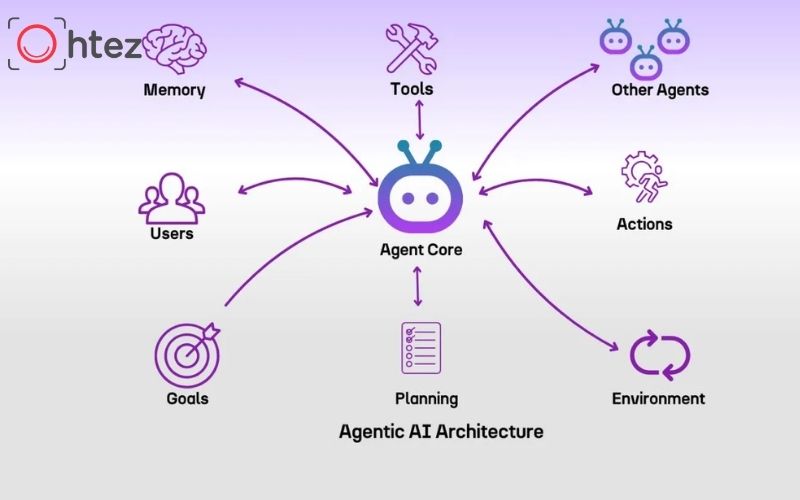
Core components of an AI Agent
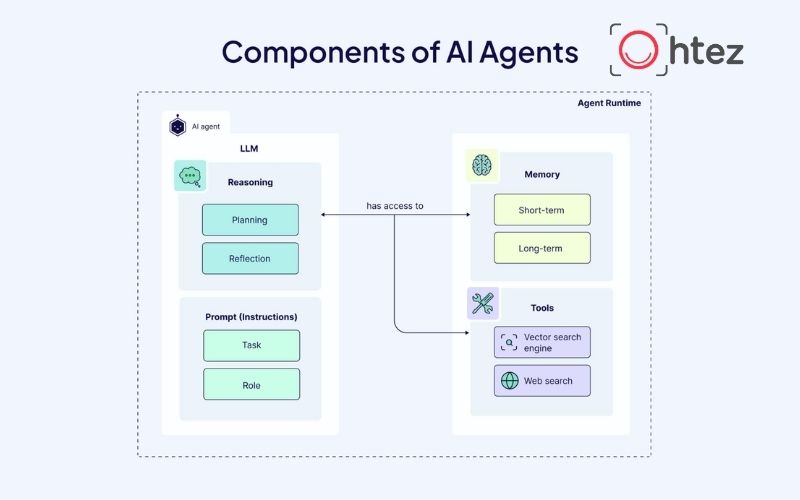
To clearly understand what is an AI Agent, businesses first need to learn about the core components that give the system its ability to observe, reason, and perform tasks. These components also provide the foundation that determines how an AI Agent operates in practice.
Core components of an AI Agent
1. Language processing and reasoning models
The language model acts as the brain of an AI Agent. This component helps the system understand instructions, identify intent, analyze context, and select a suitable processing approach. When explaining what is an AI Agent, reasoning is an important capability. The system must do more than generate a response. It also needs to recognize the relationships between different tasks.
For example, before creating a quotation, the Agent must check the customer’s requirements, suitable products, and pricing policies. However, a language model may still produce results without sufficient evidence. Businesses need to combine it with internal data, business rules, and verification steps to improve accuracy.
2. Memory for storing data and context
Memory helps an AI Agent retain information throughout the processing cycle. Without this component, the system may forget previous requests, repeat actions, or generate inconsistent results. Short-term memory usually stores information within a single working session. Long-term memory can retain interaction histories, customer preferences, or results from previous tasks.
This is an important factor in understanding what is an AI Agent in a real operational environment. Businesses need to clearly define which data can be stored, how long it should be retained, and who can access it. Encryption and permission controls allow the system to use context while protecting sensitive information.
3. Tools for connecting software and data sources
The tool helps AI agents move from analytical capabilities to concrete actions. The system can connect CRM, ERP, email, accounting software, data warehouses, or e-commerce platforms via APIs. For example, a sales Agent can check inventory, update customer information, and create an order. This integration capability clarifies what is an AI Agent compared with a conventional chatbot. High-risk operations such as data deletion, money transfers, or contract changes must have human confirmation before execution.
4. Planning and feedback mechanisms
The planning mechanism helps the AI agent determine the steps needed to achieve a goal. The system can break down a large task into smaller parts, prioritize them, and select the appropriate tools. After each action, the AI agent receives feedback from data or software to evaluate the results. If the task is not completed, the system can adjust the plan or transfer it to human personnel for handling. This clearly demonstrates what is an AI Agent: a system capable of observing, reasoning, acting, and improving. However, stopping conditions need to be established to prevent the Agent from repeating actions or consuming excessive resources.
How an AI Agent works
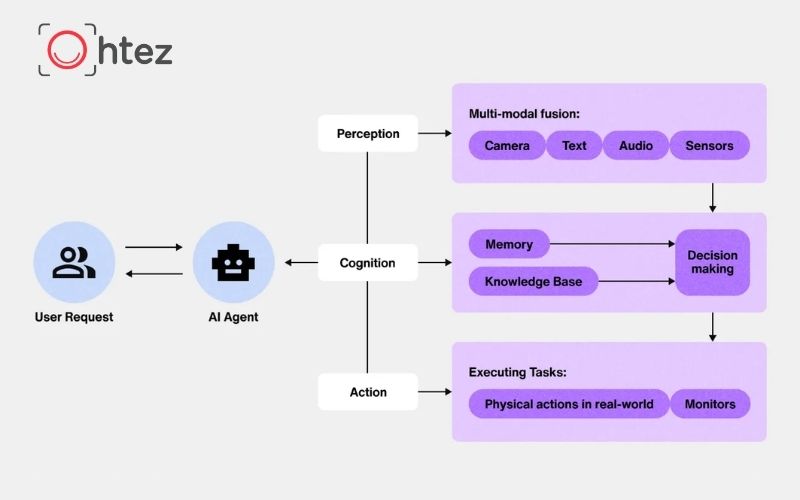
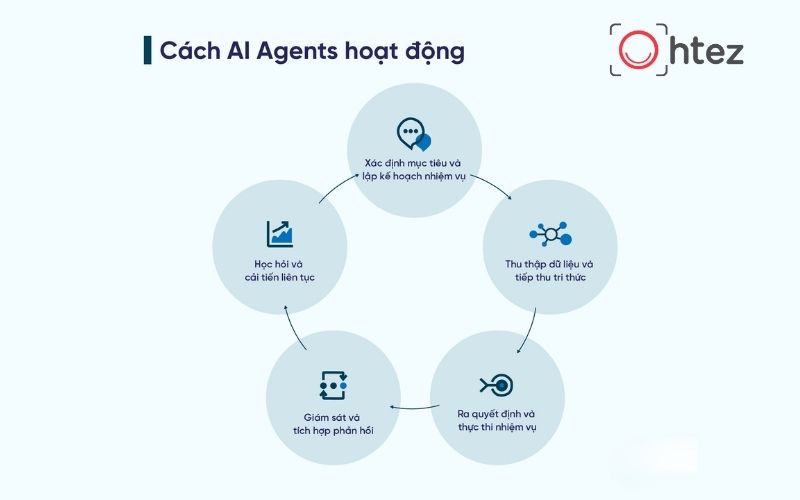
Understanding how an AI Agent works helps businesses see how the system processes requests and performs tasks. This process consists of several connected stages designed to maintain efficiency and accuracy.
How an AI Agent works
1. Receiving an objective from the user
An AI Agent can receive requests through messages, emails, forms, voice commands, or signals from software. The more specific the request, the easier it is for the system to determine its scope and completion criteria. For example, the command “compile this week’s leads and send a report” is clearer than “check the sales situation.” The Agent needs to know the time range, data source, recipient, and output format. To implement what is an AI Agent correctly, businesses should standardize input through request templates. When important data is missing, the system should ask additional questions rather than make assumptions.
2. Analyzing and breaking down the task
After receiving the objective, the AI Agent determines which activities need to be completed. A request may be divided into several steps, such as retrieving data, filtering information, performing calculations, creating a report, and sending the result. Breaking the task down helps the system process each stage in sequence and makes errors easier to identify.
For example, when preparing a revenue report, AI must select the reporting period, remove canceled orders, consolidate the data, and present the results. This planning capability helps clarify what is an AI Agent. However, when the task exceeds its access permissions or available data, the system should transfer it to the responsible employee instead of continuing to make assumptions.
3. Collecting data from appropriate sources
An AI Agent needs accurate data to generate reliable results. Information sources may include databases, internal documents, transaction histories, or real-time data from software. The system should not collect data indiscriminately. Each task needs clearly defined sources, update times, and reliability levels. For example, when checking an order status, the AI Agent must retrieve data directly from the management system. Understanding what is an AI Agent is therefore closely connected to controlled information retrieval. The more complete the data, the more accurate the result.
How an AI Agent works: Collecting data from appropriate sources
4. Executing actions with tools
After receiving the plan and data, the AI Agent uses tools to execute the task. Actions could include sending emails, creating support tickets, updating the CRM, scheduling appointments, or synchronizing data. Each tool needs to have clearly defined permissions. The customer service agent can read order status but cannot necessarily edit sales prices. The accounting agent can create reconciliation drafts but requires human approval. The ability to take action is an important part of explaining what is an AI Agent. Its value does not come from automating everything, but from completing the right task within a safe scope.
5. Self-evaluating and improving results
After completing the action, the AI Agent checks the results against the initial criteria. The system can verify that the data has been updated, the email has been successfully sent, or the report contains complete information. If an error is detected, the agent can retry within the allowed limits or transfer the task to the responsible person. This feedback loop helps improve accuracy over time. When implementing what is an AI Agent, businesses should monitor completion rates, error counts, processing times, and the level of employee intervention. These metrics help identify areas that need improvement.
How an AI Agent works: Self-evaluating and improving results
Benefits of AI Agents for business operations
After understanding what is an AI Agent and how it works, businesses can more clearly evaluate the benefits this technology offers for their operations and development. Businesses should not interpret AI Agents as a complete replacement for human personnel. AI is suited to tasks with established rules, while humans focus on strategy, creativity, and situations requiring experience.
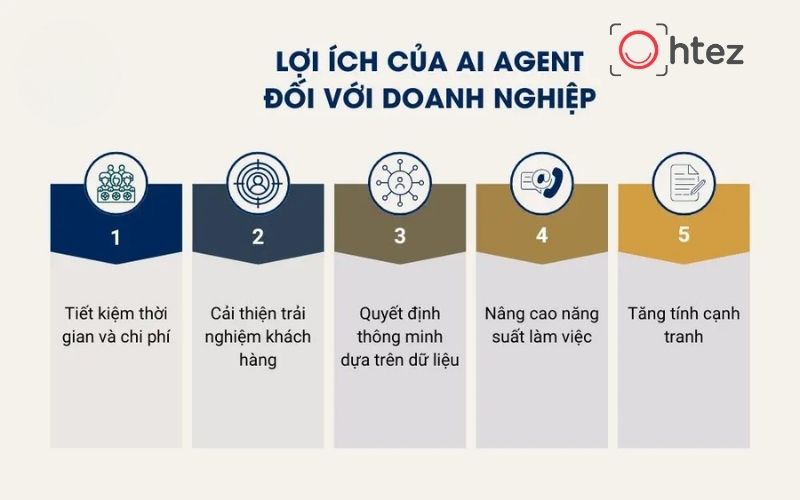
1. Automating multi-step workflows
Traditional automation typically operates according to fixed scenarios. AI agents are more flexible, able to analyze data and select actions based on specific situations. For example, the system receives a return request, checks the conditions, retrieves the purchase order, creates a processing slip, and notifies the customer. If the situation exceeds the policy, the agent forwards it to the responsible staff member. This benefit clearly demonstrates what is an AI Agent in a business environment. Instead of automating isolated actions, the Agent can coordinate an entire process.
Benefits of AI Agents for business operations
2. Improving productivity
AI agents help HR reduce the time spent searching for information, compiling reports, and entering data. An internal agent can prepare documents, categorize requests, or create drafts for employees to review. This frees up team time for specialized tasks and strategic thinking. When applying what is an AI Agent, businesses need to clearly define the system’s role in each position. Productivity should not be measured only by the volume of completed work. Relevant metrics should include processing time, output quality, correction rates, and employee satisfaction.
3. Reducing manual operating costs
AI agents can reduce costs associated with data entry, information reconciliation, and processing repetitive requests. The benefits are most apparent in high-volume, high-frequency processes. However, businesses need to factor in the costs of integration, infrastructure, maintenance, and security control. Understanding what is an AI Agent from an investment perspective requires comparing the total cost with the value created. A suitable project needs a stable process, prepared data, and clearly measurable KPIs. Small-scale testing helps businesses evaluate performance before expanding.
4. Improving customer experience
AI agents can provide continuous customer support, responding quickly and personalizing information based on interaction history. The system assists with order tracking, user guides, or categorizing requests before forwarding them to staff. However, agents need to be aware of their limitations. Complex complaints or sensitive situations should be referred to qualified personnel.
When businesses understand what is an AI Agent customer experience involves more than speed. Responses must be accurate, consistent, and appropriate to the context. Metrics to monitor include waiting time and successful resolution rates.
5. Supporting faster decision-making
AI agents can aggregate data from multiple sources, detect anomalies, and provide information to managers. For example, the system can alert about declining sales, exceeding inventory limits, or a sudden surge in advertising costs. The agent should play a supportive role rather than making decisions independently on high-impact issues. Each recommendation should be accompanied by data sources and a level of reliability. Continuous analysis expands the understanding of what is an AI Agent in business management. However, final decisions still need to combine data, experience, and real-world context.
Applications of AI Agents in business
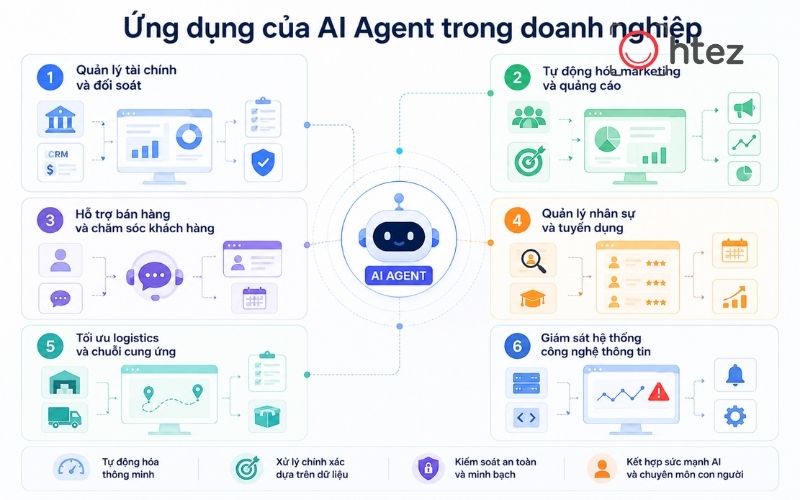
The applications of AI agents are expanding across many fields thanks to their ability to automate tasks and coordinate with other systems. Depending on their needs, businesses can deploy AI agents for specific business processes.
1. Financial management and reconciliation
In finance, AI agents can aggregate transactions, reconcile documents, categorize expenses, and detect anomalies. The system can also prepare reports or remind users of upcoming payments. For example, the agent receives data from banks and sales software, then compares transaction codes, amounts, and transaction dates. Any discrepancies are forwarded to the accounting department for verification. This application demonstrates what is an AI Agent in a process that requires a high level of accuracy. Payment approvals must still remain under human control.
Applications of AI Agents in Businesses
2. Automating marketing and advertising
AI agents can assist with customer research, data segmentation, content creation, and campaign tracking. The system can also aggregate data from multiple channels to identify underperforming ads. Businesses should provide brand identity, messaging, and approval processes for consistent output. Budget or positioning decisions still require expert review.
When teams understand what is an AI Agent, they can use the system as a tool for analysis and operations. Combining data, AI, and human experience generally produces more sustainable results.
3. Supporting sales and customer service
In sales, AI agents can categorize potential customers, update CRM, prepare sales pitches, and schedule follow-up appointments. In customer service, the system assists with information retrieval and resolving common requests. For example, after receiving data from a form, the Agent can review the customer’s needs and transfer the lead to the appropriate employee. This is an easy-to-understand application when exploring what is an AI Agent. Businesses need to set limits on the frequency of contact and establish a forwarding mechanism. AI should not send uncontrolled or intrusive content to customers.
4. Human resources and recruitment management
AI agents can assist in screening resumes based on criteria, scheduling interviews, answering internal questions, and onboarding new employees. The system can also help compile training data or remind you of performance review schedules. However, recruitment is a field prone to errors. AI should not automatically disqualify candidates based on sensitive information or unclear criteria. When applying what is an AI Agent to human resources, businesses must prioritize fairness and security. The system should only support the process, while final decisions should be evaluated by qualified professionals.
5. Optimizing logistics and supply chains
AI agents can track inventory, shipping status, restocking needs, and supply chain disruptions. The system aggregates data from warehouses, shipping companies, and sales software. When inventory levels are low, the agent can generate restocking requests or send alerts. If a delivery is delayed, the system proactively updates the customer’s status. This application clearly demonstrates what is an AI Agent in an environment where data changes continuously. Large purchasing decisions should still require managerial approval to limit risks.
6. Monitoring information technology systems
In technology management, AI agents can monitor logs, detect errors, classify alerts, and generate support tickets. Agents can also guide troubleshooting of common issues based on internal documentation. For example, when a server uses resources abnormally, the system checks the logs and sends an alert with the initial cause. For low-risk actions, the Agent may follow an approved process. To correctly implement what is an AI Agent, businesses need strict access controls, complete activity logs, and a recovery plan for incidents.
AI Agent solutions optimized for each business at Ohtez
After understanding what is an AI Agent, the important goal is not to deploy as much AI as possible but to select the right processes for automation. Ohtez develops AI agents based on the operational needs of each business, helping to reduce manual work, speed up processing, and still ensure that humans control critical decisions.
Instead of applying a general model, Ohtez designs its AI Agent to suit each industry and business size. The system can connect with CRM, ERP, Google Workspace, Shopify, and many other platforms to handle tasks directly on the existing infrastructure.
Ohtez’s AI Agent solution focuses on:
- Design the AI Agent according to the company’s business processes.
- Rapid integration with existing systems and data.
- Automate multi-step processes instead of just answering questions.
- Grant permissions, control, and monitor all activities of the AI Agent.
- Measure effectiveness using KPIs and continuously optimize after implementation.
With this approach, businesses can start with a small process, evaluate its effectiveness in practice, and then expand to other departments. This is also how businesses can apply what is an AI Agent to their operations safely and flexibly while creating long-term value.

Optimized AI Agent solutions for each business at Ohtez.
Understanding what is an AI Agent correctly is the first step toward applying AI effectively in business operations. Rather than replacing people, AI Agents provide value by automating repetitive workflows, processing data, and supporting decisions based on accurate information. To achieve long-term results, businesses should begin with specific use cases, clearly defined data, and an appropriate implementation roadmap. When a business needs an AI Agent designed around its real operational processes, Ohtez can provide support from consultation and implementation to optimization, helping the company use AI safely and sustainably.