
AI Agent vs AI Model are two concepts that businesses often confuse when they begin adopting artificial intelligence. Although both are based on AI technology, an AI Model focuses on analyzing data and generating results, while an AI Agent can plan, connect multiple tools, and perform tasks automatically. This article from Ohtez will help you understand the differences between AI Agent vs AI Model, how they work, their practical applications, and the criteria for choosing a solution that suits each implementation requirement.
What are AI Agent vs AI Model?
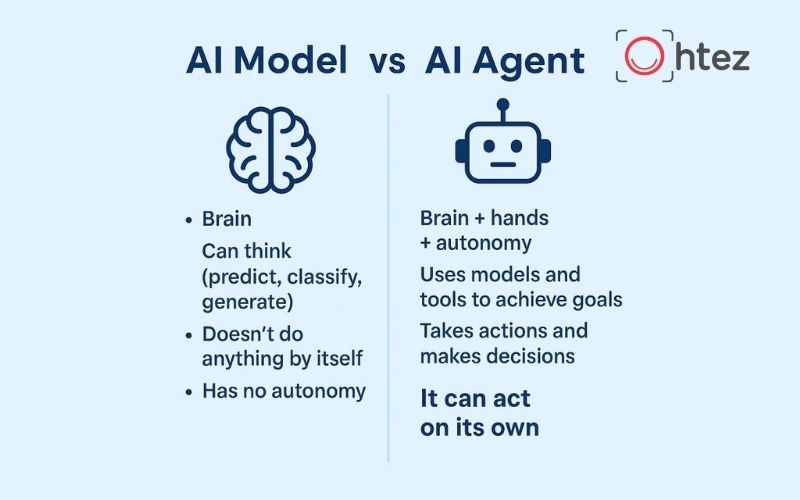
AI Agent vs AI Model are related concepts, but they cannot be used interchangeably. An AI Model focuses on processing data and generating outputs, while an AI Agent uses a Model together with multiple tools to achieve a goal. Understanding AI Agent vs AI Model correctly helps businesses choose an appropriate automation solution and avoid investing in a system that is more complex than their actual needs.
The concept of an AI Model
An AI Model is a system trained on data to recognize patterns, predict outcomes, or generate new content. In the comparison between AI Agent vs AI Model, the Model acts as the “brain” that processes information. For example, a language model can generate text, while a computer vision model can identify objects in images. A customer service AI Agent, for instance, can do more than generate a response. It can access a CRM, review purchase history, create a support ticket, and send a confirmation email after the conversation ends. This enables the AI Agent to function as an automated system rather than merely a content-generation model.
The concept of an AI Model
The concept of an AI Agent
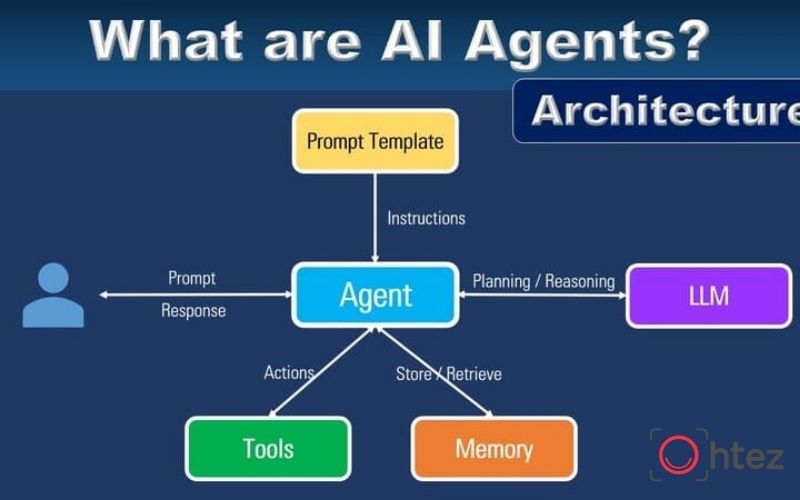
An AI Agent is an intelligent system capable of using an AI Model to achieve a specific objective. Instead of only responding to a request, an AI Agent can create a plan, divide a task into smaller steps, select appropriate tools, and perform several consecutive actions to produce the desired result.
For example, a customer service AI Agent can do more than generate a response. It can access a CRM, review purchase history, create a support ticket, and send a confirmation email after the conversation ends. This enables the AI Agent to function as an automated system rather than merely a content-generation model.
The concept of an AI Agent
An important point in AI Agent vs AI Model is that an AI Agent always requires one or more AI Models as the foundation for processing language, images, or data. In simple terms, an AI Model provides the “ability to think,” while an AI Agent transforms that capability into a complete series of actions that serves the business.
The relationship between AI Agent vs AI Model
To understand AI Agent vs AI Model correctly, they should not be viewed as competing technologies but as complementary components. An AI Model provides the ability to analyze, reason, and generate content, while an AI Agent is responsible for coordinating the entire process to accomplish a defined objective.
A simple way to understand the relationship is to compare an AI Model to a car engine and an AI Agent to the driver who determines the destination, selects the route, and handles unexpected situations along the journey. With only an AI Model, a system may be able to answer questions but cannot automatically perform tasks. In contrast, an AI Agent uses the power of an AI Model together with workflows, APIs, and external tools to create a complete operational process.
How does AI modeling work?
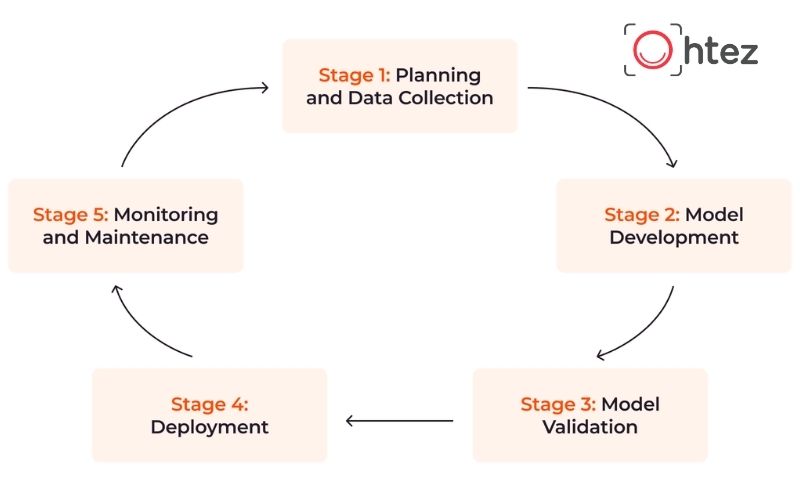
To understand AI Agent vs AI Model, it is necessary to know how a Model learns from data and generates results. An AI Model usually goes through the stages of data collection, training, evaluation, and deployment. When receiving new data, the Model uses its learned parameters to make inferences rather than independently taking action in an external environment.
1. Data, algorithms, and training process
Data provides the information that allows a Model to recognize patterns. Machine learning algorithms adjust parameters to reduce the difference between predicted results and actual outcomes. In AI Agent vs AI Model, the quality of a Model depends heavily on its training data, evaluation methods, and suitability for the problem it is intended to solve.
This is also an important difference in AI Agent vs AI Model. An AI Model focuses on processing and reasoning about information, while an AI Agent uses the result to continue planning and taking action in a real-world environment.
How an AI Model works: Data, algorithms, and the training process
2. How a Model generates predictions or content
When receiving input, a Model performs inference to calculate the output with the highest probability. A classification model may identify spam emails, while an LLM generates responses based on context.
An important point in AI Agent vs AI Model is that a Model generates a result but does not independently decide what should happen next. For example, when a user enters a question, a language model analyzes the context and predicts the next word or sentence with the highest probability. In a classification task, an AI Model evaluates the characteristics of the data to determine which category the result belongs to.
3. Common types of AI models
Many types of AI Models are currently available for different purposes. Selecting the right Model directly affects the effectiveness of AI implementation within a business.
Common categories include:
- Large Language Model (LLM): Generates text, answers questions, summarizes content, and supports conversations.
- Computer Vision Model: Identifies images, faces, products, or manufacturing defects.
- Speech Model: Converts speech into text or generates natural-sounding speech.
- Predictive Model: Forecasts sales, market demand, risks, or customer behavior.
- Recommendation Model: Recommends products, content, or services based on user behavior.
When analyzing AI Agent vs AI Model, it is clear that an AI Agent does not replace these Models. Instead, it uses them as capability blocks for handling specialized tasks. A modern AI Agent can even coordinate multiple AI Models simultaneously to manage complex workflows, from data analysis to the automated execution of business tasks.
How does an AI Agent work?
An AI Agent operates through a cycle of receiving an objective, observing data, planning, acting, and checking the result. When comparing AI Agent vs AI Model, an Agent does more than generate an answer. It coordinates multiple components to complete a task. Its level of autonomy can be limited through rules, access permissions, and approval mechanisms.
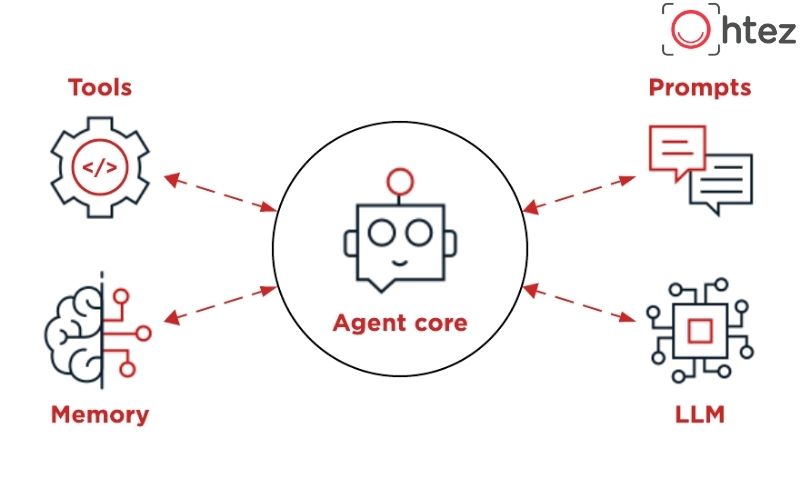
How an AI Agent operates
1. Objectives, planning, and actions
An Agent begins with an objective, such as compiling a report or handling a customer request. The system divides the task into smaller steps, selects the sequence, and performs the required actions. Compared with a Model, AI Agent vs AI Model differ clearly in the Agent’s ability to create multi-step plans instead of processing only one independent request.
For example, when assigned the task “prepare the weekly sales report,” an AI Agent can automatically retrieve data from the sales system, consolidate the figures, create charts, write the analysis, and send the report to the manager. The entire process can take place with almost no human intervention after the task has been assigned.
2. Ability to use external tools
An AI Agent can connect to CRM platforms, management software, databases, email, or search tools through APIs. For example, when a customer asks to check an order status, the AI Agent does not simply respond with content generated by an AI Model. It queries real data from the sales system and provides an accurate, real-time response.
The ability to use tools allows an Agent to turn reasoning results into real actions. This is a notable distinction when comparing AI Agent vs AI Model, particularly in business automation processes.
3. Memory and feedback loops
Memory allows an Agent to store context, action history, and information required for subsequent steps. After each action, the system checks the result and adjusts its plan. In AI Agent vs AI Model, this feedback mechanism allows the Agent to adapt more effectively, but it also requires monitoring to prevent repetition or incorrect processing.
How do AI Agent vs AI Model differ?
AI Agent vs AI Model are two concepts that businesses often confuse when learning about artificial intelligence. Although both use AI, each solution has a different role and operating mechanism. An AI Model focuses on processing data and generating results, while an AI Agent can plan, use tools, and perform multiple actions to achieve an objective. The table below provides a quick comparison of AI Agent vs AI Model according to important criteria.
|
Criteria |
AI Model |
AI Agent |
| Purpose of use | Analyze data, make predictions, or create content. | Achieve your goals through multiple steps and actions. |
| Information processing ability | Strong in specialized tasks such as classification, forecasting, and text generation. | Combine multiple models and data sources to address the overall problem. |
| Level of autonomy | It operates when it receives input from the user or the system. | It is possible to plan and decide on the next step within the given scope. |
| Memory and State | Typically, context is only maintained during the processing session. | Short-term and long-term states can be saved to track progress. |
| Executability | Create results or make suggestions, don’t take action yourself. | It is possible to call APIs, update data, send emails, and execute workflows. |
| Environmental interaction capabilities | Mainly processing input data | It can read real-time data, respond to and adjust to the environment. |
| Cost and complexity of implementation | Lower, simpler architecture | Higher cost due to the need to integrate tools, memory, and scheduling mechanisms. |
| Suitable use case | Document classification, forecasting, content creation, image recognition | Customer service, marketing, operations, multi-step process automation. |
| Operational risks | Incorrect predictions or inaccurate content creation. | Mistakes can be made if there is a lack of mechanisms to control authority. |
The table shows that AI Agent vs AI Model are not technologies that replace one another. Instead, they complement each other. An AI Model is suitable for analytical or content-generation tasks, while an AI Agent is appropriate for processes requiring multi-step automation and integration with multiple systems. The solution should be selected according to the objective, implementation scale, and level of automation the business wants to achieve.
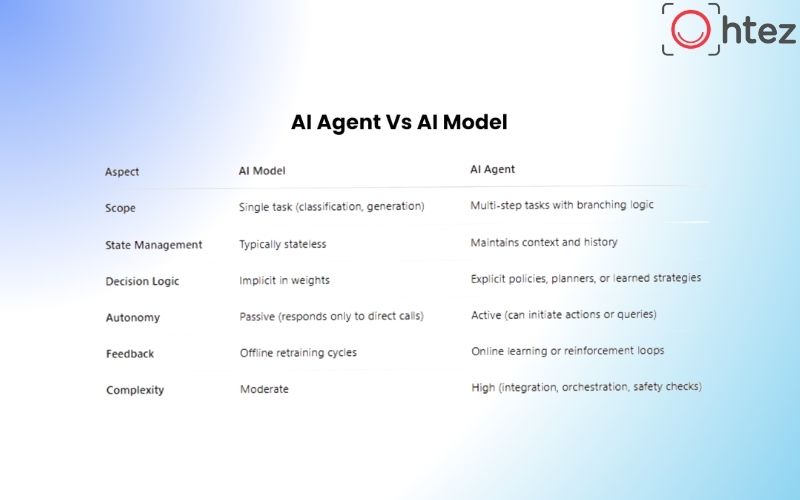
How do AI Agent and AI Model differ?
Practical applications of AI Agent vs AI Model
AI Agent vs AI Model are not competing solutions. They are often combined within the same AI system. An AI Model is responsible for analyzing data and generating results, while an AI Agent uses those results to make decisions, connect tools, and execute processes automatically. Depending on the use case, a business may deploy only an AI Model or combine it with an AI Agent to achieve a higher level of automation.
Data analysis and decision-making support
AI models are effective in tasks with clear inputs and outputs, such as sales forecasting, customer segmentation, image recognition, or sentiment analysis from feedback. The results generated by the model help businesses make faster and more accurate decisions, but do not directly lead to action. In the context of AI Agent vs AI Model, an AI Model is suitable when a business needs to use data to support decision-making while keeping humans in control of all subsequent steps.
Automating customer service and Marketing
When multiple consecutive steps need to be handled, AI Agents offer higher efficiency. In customer service, Agents can receive inquiries, check orders, access CRM data, respond to customers, and forward requests to staff if necessary. In marketing, Agents assist in aggregating campaign data, tracking KPIs, generating reports, and sending notifications when anomalies are detected. This is a major difference between AI Agent vs AI Model, as an Agent does more than generate content. It coordinates multiple systems to significantly reduce manual work.
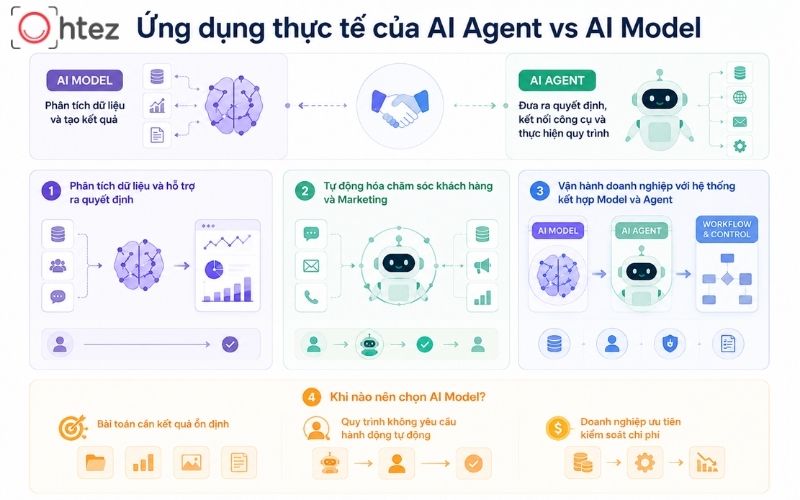
Practical applications of AI Agent and AI Model
Operating a business with a combined Model and Agent system
In practice, many businesses combine AI Models and AI Agents to benefit from the strengths of both technologies. The AI Model analyzes data or generates content, the AI Agent coordinates the process, and the workflow controls the steps that require approval or regulatory compliance.
For example, when a customer email is received, the AI Model analyzes the content and identifies the request. The AI Agent then accesses the CRM to check the information, creates a support ticket, sends a response email, and updates the task status. This implementation allows AI Agent vs AI Model to deliver maximum effectiveness while maintaining operational control and safety.
When should you choose an AI Model?
Not every problem requires an AI agent. In many cases, an AI model is sufficient to deliver effective results at a low cost and with easy control. When considering AI Agent vs AI Model, businesses should prioritize an AI Model when the main objective is to analyze data, generate content, or support decision-making without requiring the system to perform actions automatically.
You should choose an AI model when:
- The task requires consistent results: It is suitable for document classification, sales forecasting, image recognition, or data extraction. An AI Model produces consistent results that are easy to evaluate using metrics such as accuracy or error rate.
- The process does not require automated actions: When a person still reviews the result and performs the next step, an AI Model is an appropriate option. For example, AI may only summarize a report or recommend a response for an employee to review before sending.
- The business prioritizes cost control: An AI Model has a simpler architecture and fewer integrated components, so implementation and operating costs are generally lower than those of an AI Agent. It is also a suitable choice for testing AI before expanding into more complex automation processes.
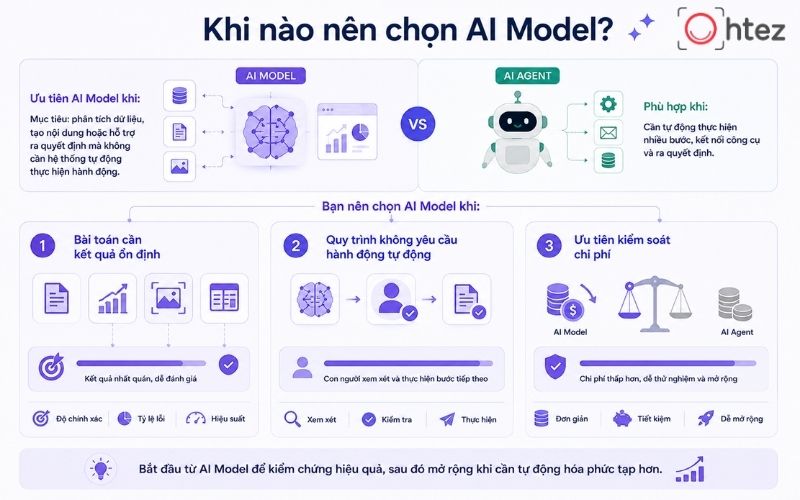
When should you choose an AI Model?
When should you implement an AI Agent?
AI agents are suitable when tasks involve multiple steps, multiple data sources, and frequently require action selection. In AI Agent vs AI Model, an Agent provides the greatest value when a business has a clearly defined process that still includes changing situations. The system should be deployed within a limited scope before being expanded.
You should deploy an AI Agent when:
- The work requires multiple processing steps: An AI Agent can receive a request, collect data, analyze information, select an appropriate response, and update the result in the system. These are workflows that a standalone AI Model would struggle to handle from beginning to end.
- The process changes frequently: When the input data or processing method is not fixed, an AI Agent can evaluate the context and select a suitable approach. Businesses should still establish approval mechanisms for important decisions to maintain safety.
- The task requires connections with multiple tools: An AI Agent can work with CRM, ERP, email, spreadsheets, or internal software simultaneously through APIs. This allows data to be synchronized automatically across multiple systems, reducing processing time and limiting errors caused by manual operations.
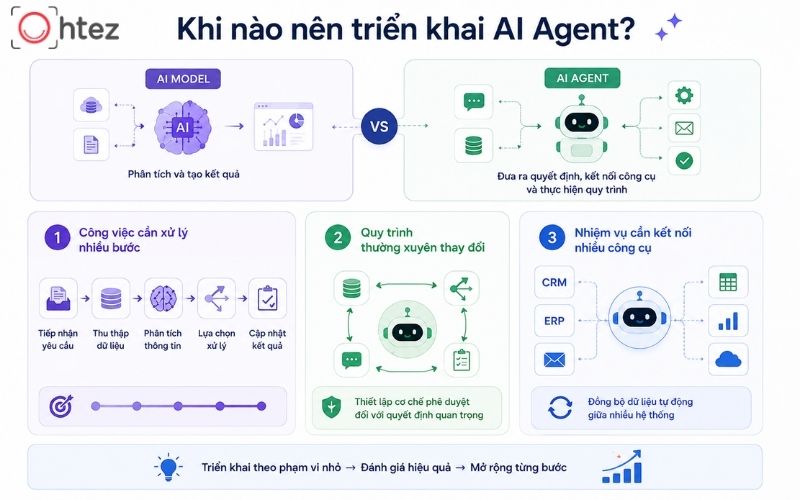
When should you implement an AI Agent?
AI Agent solutions designed around business workflows
After understanding the differences between AI Agent vs AI Model, businesses can identify the solution that best matches their actual requirements. However, for AI agents to be effective, implementation goes beyond simply choosing an AI model; it also requires process design, system integration, and the establishment of appropriate control mechanisms. Ohtez provides AI agent design services tailored to individual real-world scenarios, helping businesses deploy AI safely and with scalability.
Key features of Ohtez’s AI Agent solution:
- Designed around business workflows: AI Agents are developed according to actual business objectives and operating processes rather than using a prebuilt model.
- Flexible integration: The Agent connects to CRM, ERP, email, Google Workspace, and other software to synchronize data and optimize workflows.
- Multi-step automation: An AI Agent can receive requests, process data, and complete tasks according to an established workflow.
- Phased implementation: Businesses begin with priority processes and evaluate effectiveness before expanding, helping optimize costs and reduce risks.
- Support from consultation to operation: The Ohtez team supports businesses throughout requirements assessment, AI Agent design, system integration, monitoring, and post-deployment optimization. This helps AI generate long-term value rather than remaining at the experimentation stage.
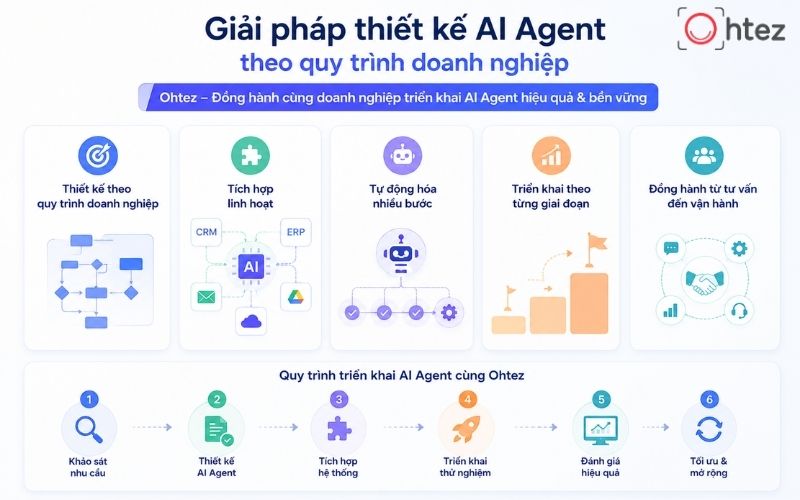
AI Agent solutions designed around business workflows at Ohtez
Choosing between AI Agent vs AI Model does not depend on which technology is more advanced. It depends on the business’s objectives and processes. An AI Model is suitable for data analysis, forecasting, or content-generation tasks, while an AI Agent is effective in processes requiring multi-step automation and connections across multiple systems. When a business needs an AI Agent solution designed around its actual operating processes, Ohtez can provide support from consultation and design to implementation, helping the company apply AI effectively, safely, and in a way that supports its long-term growth.