
AI Agents are being adopted increasingly widely across businesses. However, for these systems to handle tasks accurately and consistently, each task must be defined through suitable Agent Skills. So, What is AI Agent Skill, how does it work, and how can businesses build one effectively? In this article, Ohtez will explore the concept, operating mechanism, development process, and practical applications of Agent Skills.

What is AI Agent Skill? Structure and role in an AI Agent
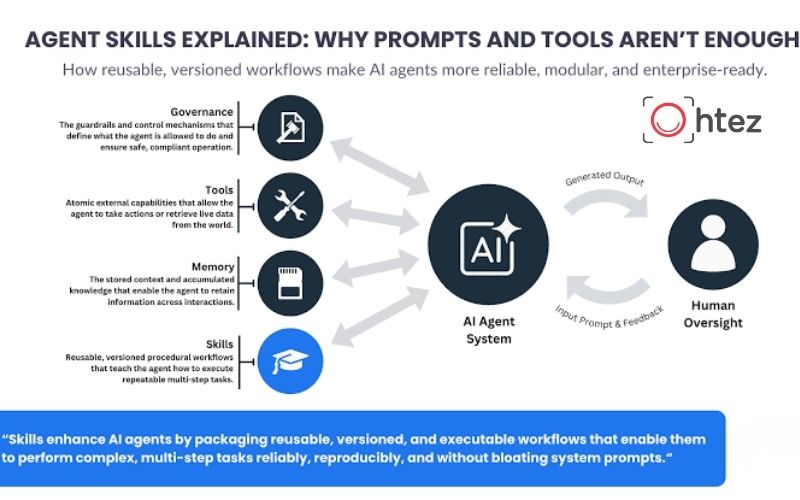
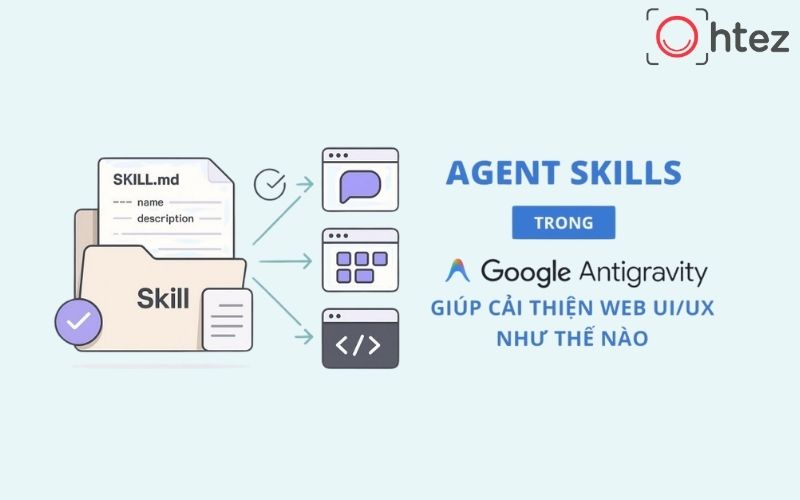
What is AI Agent Skill? Simply put, it is a package of instructions that helps an AI Agent complete a specific task according to a predefined process. Each Skill may include an objective, input data, processing steps, permitted tools, and the required output format. Instead of describing the entire process again during every interaction, users only need to activate the correct Skill for the AI Agent to complete the task consistently.
The primary role of Agent Skills is to standardize experience and workflows so that an AI Agent can reuse them in different situations. Rather than relying on lengthy prompts that must be rewritten repeatedly, businesses can build a Skill once and apply it to similar tasks. This approach reduces processing time, maintains consistent output quality, and makes workflows easier to expand or update.
To complete a task correctly, an Agent Skill is usually built from several components. The structure may vary by platform, but most Skills include the following core elements:
- Objective: Defines the task that the Skill needs to complete.
- Trigger: Specifies when the AI Agent should use the Skill.
- Workflow: Describes each processing step according to the relevant business process.
- Tools and resources: Specifies the tools, APIs, or documents that the Agent is permitted to access.
- Output: Defines how the result should be presented to ensure consistency and usability.
Designing all of these components thoroughly makes an Agent Skill easier to reuse, maintain, and expand. Understanding What is AI Agent Skill also helps businesses choose the right approach to building and managing Agent Skills, thereby improving the effectiveness of AI Agent deployment in practice.
What is an What is AI Agent Skill? Its structure and role in an AI Agent.
How does AI Agent Skill work?
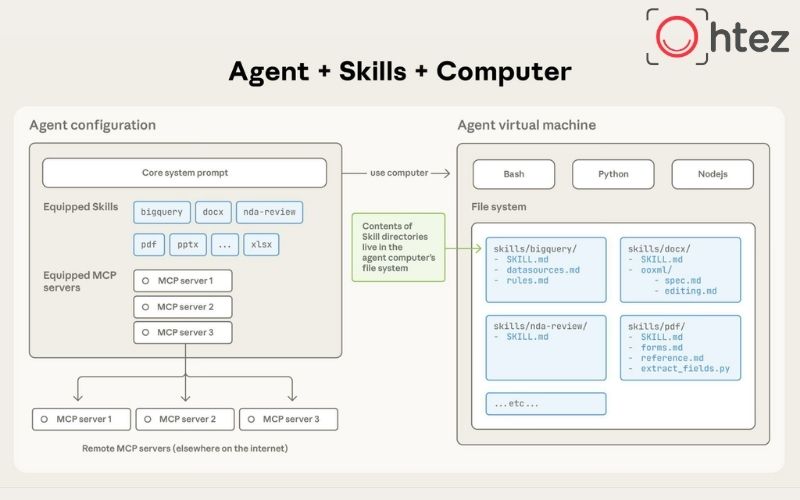
After understanding What is AI Agent Skill, the next step is to examine how an AI Agent uses a Skill to complete a task. Instead of loading all available instructions at all times, the AI Agent only activates the Skill that matches the user’s request. This mechanism allows the system to process tasks more accurately, reduce unnecessary information, and scale more easily when new capabilities are added.
1. Identifying the request and selecting the right Skill
When receiving a command, the Agent analyzes its meaning and compares it with the names, descriptions, or scopes of the available Skills. When a user asks the system to review an article, it may activate an SEO Audit Skill. When the user submits a PDF report, a document-processing Skill may be more appropriate.
A Skill description should clearly state:
- The task that the Skill addresses.
- When the Skill should or should not be used.
- The required input data.
- The type of result it generates.
When exploring What is AI Agent Skill, many people focus only on the instructions and overlook the description. In practice, the description is the basis that allows the Agent to route a request to the correct Skill. A vague description may prevent the Skill from being activated or cause it to be selected for the wrong purpose.
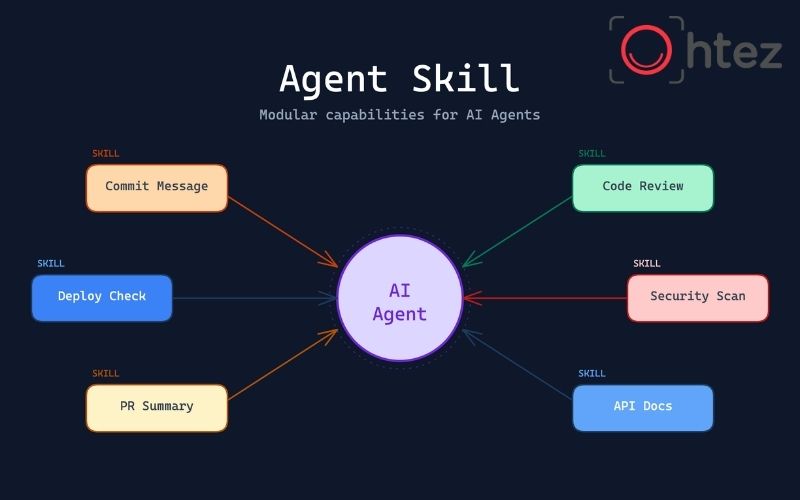
How does What is AI Agent Skill work?
2. Loading instructions through Progressive Disclosure
Progressive Disclosure can be understood as a mechanism for revealing information gradually. At first, the Agent only sees the name and brief description of each Skill. Detailed instructions are loaded only after the system has identified the appropriate Skill.
This mechanism usually consists of three levels:
- Level 1: Load metadata such as the name and description.
- Level 2: Read the detailed instructions in SKILL.md.
- Level 3: Use scripts, templates, or reference documents when necessary.
Progressive Disclosure is an important part of explaining What is AI Agent Skill. When every Skill is loaded from the beginning, the context window contains a large amount of irrelevant information. This can distract the Agent, consume more tokens, and cause it to apply the wrong rules. Loading only the necessary instructions allows the reasoning process to remain more focused.
3. Coordinate tools and export results
After loading the instructions, the Agent begins executing the workflow. Depending on the task, the system may read files, call APIs, query data, run scripts, or create documents. The Skill does not necessarily perform these actions directly. Instead, it guides the Agent in using the tools in the correct sequence.
For example, a report-generation Skill may require the Agent to:
- Check the reporting period and data sources.
- Remove duplicate records.
- Calculate metrics through a script.
- Compare the results with the previous period.
- Write the analysis.
- Verify the figures before generating the report.
Therefore, when understanding What is AI Agent Skill, businesses should view a Skill as the orchestration layer between business requirements and execution tools. Output quality depends on both the instructions and the verification mechanism.
How related technologies differ from What is AI Agent Skill
Agent Skills are often confused with Tools, System Prompts, and Rule Engines because all of them influence how an AI Agent receives and completes tasks. However, each component has a distinct role within the system. The following table provides a detailed comparison:
| Criteria | What is AI Agent Skill | Tool | System Prompt | Rule Engine |
| Concept | This training package helps agents perform a professional procedure. | This function allows the Agent to perform an action. | A set of fundamental guidelines to guide the entire Agent. | System of rules for controlling conditions and limits |
| Main role | Instructions on how to complete the task | Provide execution capabilities | Establish general roles, behaviors, and principles. | Determine what is allowed or not allowed. |
| Question to solve | How should the work be done? | Which function does the agent need to use? | What direction should the agent operate in? | Does the action comply with regulations? |
| Scope | A specific business process or workflow | A single action | The entire session or system | A set of defining conditions |
| Time of application | When a suitable task arises | When the agent needs to take action. | Right from the start of the work session | Before, during, or after performing the task |
| How to activate | The agent is selected based on the request or the user calls directly. | Called by the Agent during the Skill execution. | Loaded by default by the system. | Automatically check when relevant conditions occur. |
| Main content | Workflow, checklist, conditions, output format | Source code, API, or executable functionality | Roles, tone, policies, and general limitations | Conditional statements and control actions |
| Reasoning ability | It is possible to guide the agent to reason and choose the appropriate processing step. | Do not make your own judgments, just follow orders. | Guide the Agent’s reasoning process. | Usually evaluated according to fixed rules. |
| Level of flexibility | Tall, contextually adjustable | Low, dependent on the designed function. | Relatively stable, with little change. | Low to medium, depending on the rule system. |
| Ability to use the tool | It is possible to coordinate one or more tools. | It is an execution tool in itself. | It is possible to specify which tools are allowed to be used. | It is possible to allow or block calls to the Tool. |
| The result produced | The complete result of a process | The result of an operation | Do not directly generate your own results. | Decision to allow, deny, or proceed |
| For example | SEO checking, invoice processing, report generation. | OCR, file reading, API calls, code execution. | Requires AI to provide honest and secure responses. | Blocking personal data from public reports. |
| Combination method | Instruct agents to use the tool within the permitted scope. | Perform the action as requested by the Agent. | Establish a common operating platform for Agents. | Control skills and tools according to policy. |
| When should it be used? | The task is repetitive, involves multiple steps, and requires standardization. | Tasks with defined inputs and outputs | The principle to be maintained in all tasks. | The regulations must be followed. |
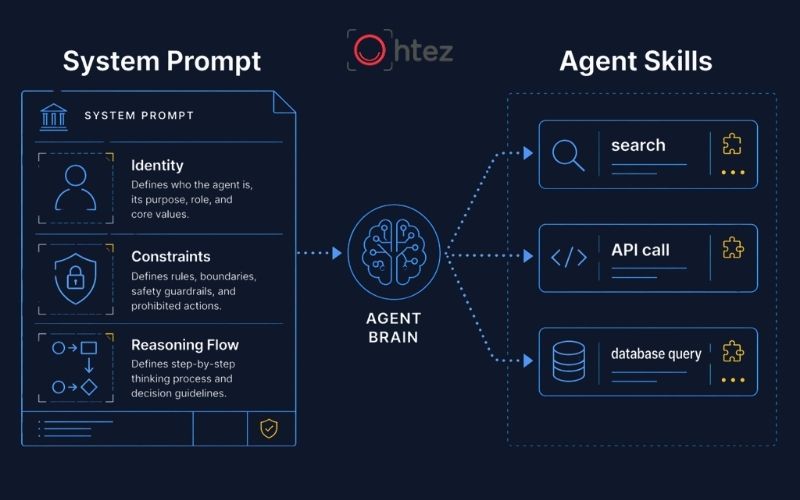
What are the differences between the technologies related to What is AI Agent Skills?
In simple terms, the System Prompt establishes the operating foundation, an Agent Skill guides the workflow, a Tool performs each action, and the Rule Engine controls limitations. These four components work together so that an AI Agent can complete tasks flexibly while maintaining consistency and safety.
How to build reliable What is AI Agent Skills
After understanding What is AI Agent Skill, businesses can begin developing Agent Skills through a clear process. Rather than trying to create one Skill that handles every task, each Skill should have a specific scope so that it is easier to test, maintain, and expand later.
Step 1: Define the tasks and outputs
After understanding What is AI Agent Skill, the first step in building an Agent Skill is to clearly define the task and expected result. Each Skill should handle one specific function rather than multiple activities within the same process. For example, a Skill dedicated to identifying on-page SEO issues will be more effective than asking AI to conduct keyword research, create a content plan, and optimize the entire SEO strategy simultaneously.
Applying the principles of AI Agent Skill correctly begins with defining the objective, target users, input data sources, and output format. When a process includes several independent steps, divide it into smaller Skills and connect them into a complete workflow. This design makes the AI Agent easier to test, maintain, and expand as usage requirements change.
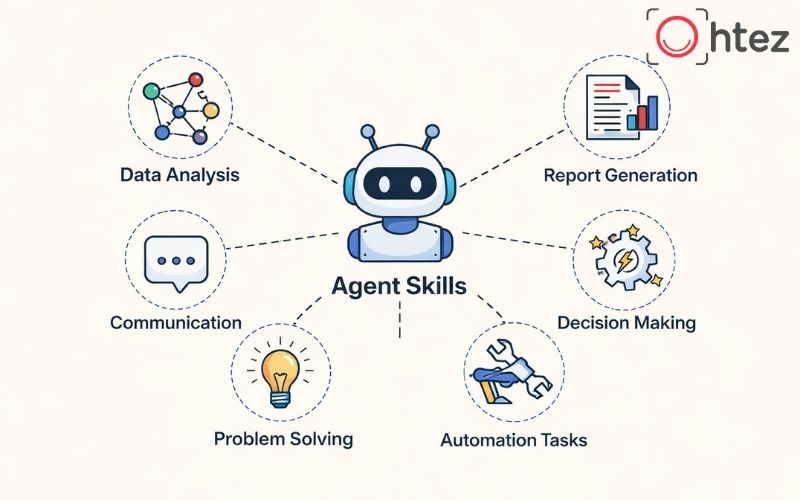
How to build reliable What is AI Agent Skills
Step 2: Write an accurate trigger description.
After defining the task, the next step is to create an activation description that helps the AI Agent identify the correct time to use the Skill. This is also one of the most important principles when implementing What is AI Agent Skill. The clearer the description, the easier it becomes for the Agent to select the right Skill and avoid accidentally activating Skills with similar functions.
An effective description should clearly state the item being processed, the action the AI must perform, the expected output, and the situations in which the Skill should not be activated.
For example, instead of writing “Support content writing,” use: “Analyze an SEO article, review its heading structure and topic coverage, and recommend internal links.” When businesses understand What is AI Agent Skill and how to write activation descriptions, they can develop Skills that identify requests more accurately and operate more consistently.
Step 3: Process design and error handling
After completing the description, the next step is to build a workflow with clearly defined processing stages. Each stage should specify the Tool being used, the data that needs to be checked, the conditions for moving to the next step, and the completion criteria. The Skill also needs an error-handling mechanism for situations such as missing input data, unreadable files, unresponsive APIs, or inconsistent results across multiple sources.
Instead of making assumptions, the AI Agent should request additional information or transfer the task to the responsible employee when there is insufficient evidence. This is an important principle that allows AI Agent Skill to work effectively in an enterprise environment while reducing AI hallucinations.
Step 4: Find suitable What is AI Agent Skills GitHub
GitHub is a useful resource for finding AI Agent Skills templates, SKILL.md structures, and existing workflows. Reviewing open-source projects can shorten Skill development time and provide insights into how a professional AI Agent is organized. However, before using these resources, you should carefully check the source, update history, documentation, access permissions, executable scripts, and licensing terms.
Templates should not be copied without modification. They need to be adapted to the company’s workflows, data, and security requirements. This is also the final step in developing an Agent Skill that is stable, secure, and easy to expand in practice.
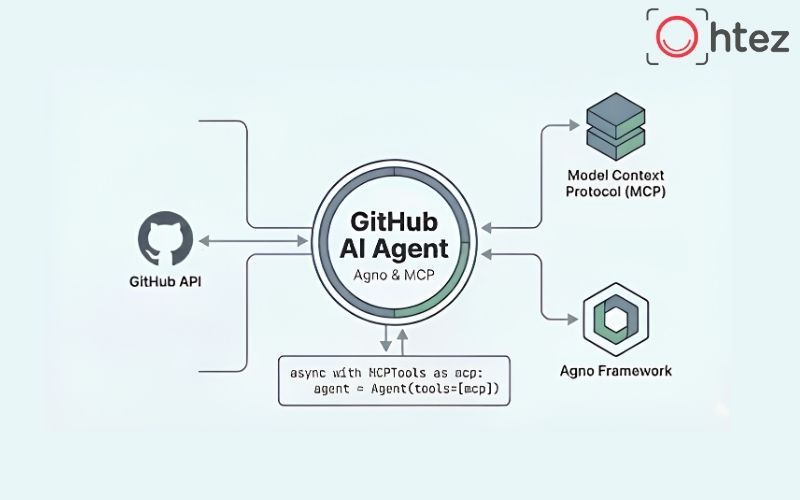
Find the right AI Agent Skills GitHub match
Practical examples of Agent Skills
After understanding What is AI Agent Skill?, the easiest way to visualize this is to look at real-world application scenarios. Agent Skills help AI perform a standardized process instead of just responding to prompts. Below are some common examples that businesses can implement to improve operational efficiency.
Extracting data from PDF documents
An AI Skill can automatically read PDF documents, identify important information, and convert the data into a structured format. For image documents, the AI Agent will incorporate OCR before processing to increase accuracy.
Example process:
- Identify the document type and provider.
- Extract the invoice number, issue date, and amount.
- Check for data consistency.
- Mark the fields that are unreadable.
- Export the results as CSV or JSON.
This implementation reduces manual data entry time while ensuring data is standardized before being entered into the system.
Automated SEO checking and optimization
In SEO, Agent Skill can assist in quickly checking an article before publication. Instead of just providing general feedback, the AI will evaluate each item according to a checklist and suggest areas for improvement.
For example, PerhapsAgent Skills can be developed to:
- Keyword analysis and search intent analysis.
- Check the title, meta description, and heading.
- Missing or duplicate content detected.
- Suggest suitable internal links.
- Create an optimal checklist before publishing.
This is a real-world example to show What is AI Agent Skill? in content SEO, AI helps standardize the review process, but human specialists still decide on the strategy and direction of the content.
Analyze data and generate reports.
Agent Skill can also automatically aggregate data, calculate metrics, and generate reports using pre-designed templates. This helps businesses shorten data processing time and focus on analyzing results.
Example process:
- Collect data from spreadsheets.
- Calculate the necessary indicators.
- Compare the results between the stages.
- Unusual fluctuations detected.
- Create a report including observations and recommendations.
In this case, AI handles the synthesis and interpretation, while the calculations are performed by a script or specialized tool to ensure accuracy.
Examples of Agent Skills in practice.
Standardize customer service processes.
In customer service, Agent Skill can receive requests, categorize issues, and automatically handle common cases according to established procedures. Situations requiring assessment or approval will still be forwarded to the responsible staff member.
For example, an Agent Skill could:
- Answering frequently asked questions from the knowledge base.
- Categorize and forward complaints to the correct department.
- Support the refund process according to policy.
- Protect sensitive data in accordance with regulations.
This example shows that What is AI Agent Skill is not to replace people, but to standardize repetitive tasks so that employees can focus on tasks requiring expertise and decision-making skills.
Should businesses build What is AI Agent Skills from scratch?
After understanding What is AI Agent Skill and how it works, many businesses will consider the choice between building their own Agent Skills or using a deployment service. Each option has its own advantages, depending on the technical team, the complexity of the process, and the goals of applying AI in the business.
When should businesses build Agent Skills themselves?
Businesses should develop their own Agent Skills if they already have an AI or Developer team, relatively simple business processes, and sufficient time for testing and optimization. This approach allows them to proactively adjust skills to needs and accumulate long-term AI deployment experience.
When should businesses use Ohtez’s AI Agent services?
If you lack a specialized team or need rapid deployment, using an AI Agent service can shorten development time and reduce testing costs. Instead of creating individual Agent Skills, Ohtez provides support for business process analysis, AI agent and agent skills design, integration with systems such as CRM, ERP, or Google Workspace, and testing and optimization before deployment. Businesses are also guided on how to easily scale up as needs grow.
This approach also helps businesses better understand what is AI Agent Skill and how to apply Agent Skills effectively in real-world workflows.
Should businesses build What is AI Agent Skills from scratch?
Clearly understand What is AI Agent Skill? is the first step for businesses to effectively leverage AI Agents in activities such as marketing, sales, customer service, or operations. Instead of relying on fragmented prompts, Agent Skills help standardize processes, improve output quality, and create a foundation for future automation expansion. If your business needs consulting or implementation of AI Agents according to your business processes, Ohtez are ready to partner with you from requirements analysis and agent skills development to system integration and optimization, helping AI deliver real value to your business operations.