
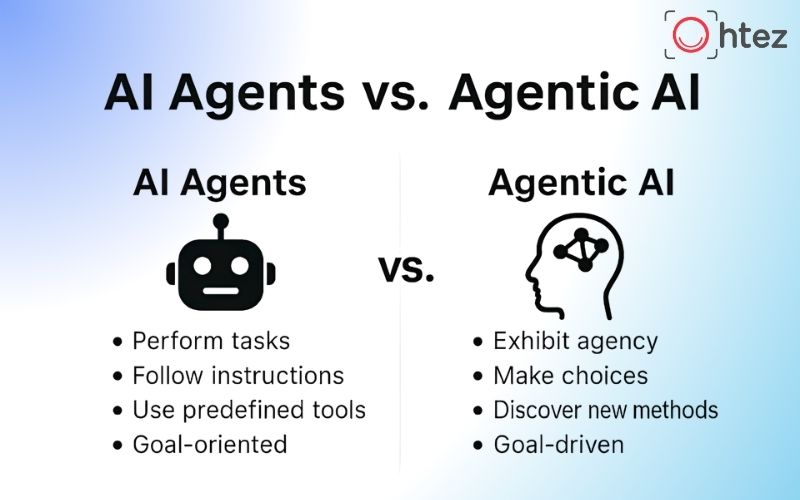
In business automation, AI Agent and Agentic AI are often treated as interchangeable concepts. However, they differ significantly in processing scope, autonomy, and orchestration capabilities. An AI Agent is typically designed to complete a specific task, while Agentic AI can create plans, connect multiple agents, and manage complex workflows. In this article, Ohtez explains these differences in detail, helping businesses choose the right technology, avoid unnecessary investment, and prevent the deployment of systems that fail to meet their operational goals.
What Is an AI Agent? Definition and Operating Principles
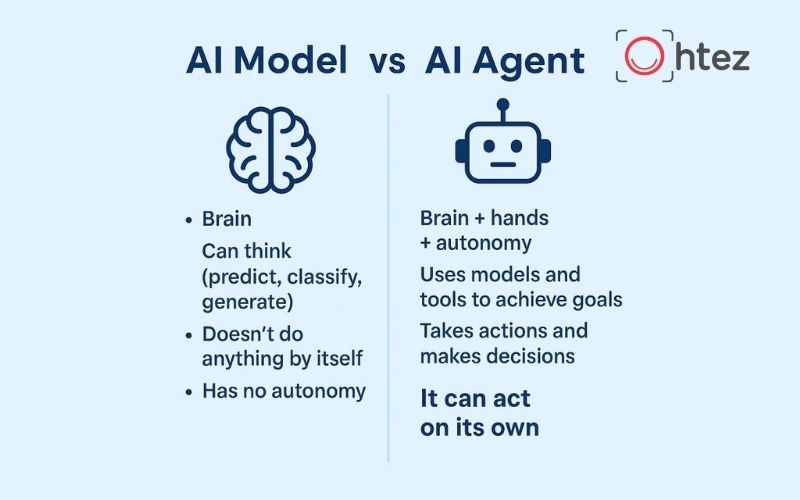
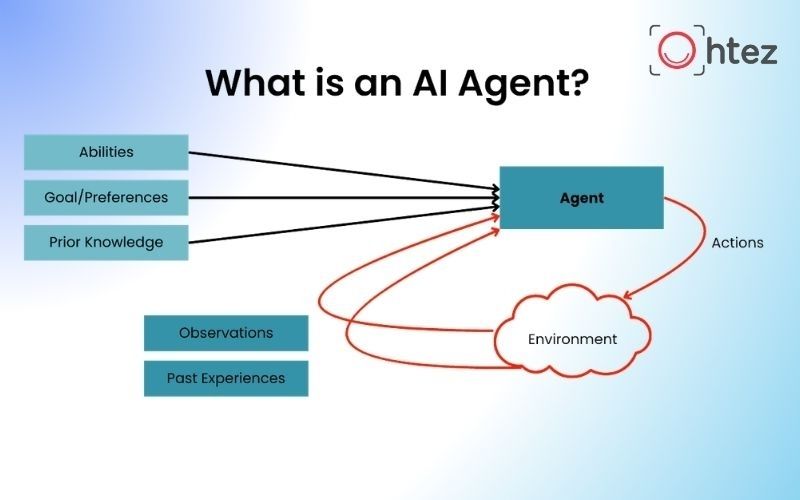
An AI Agent is an artificial intelligence system capable of independently receiving requests, analyzing information, and taking action to complete a specific task. Unlike conventional chatbots that mainly respond through predefined scripts, AI Agents can connect to CRM platforms, ERP systems, databases, and APIs. This allows them to perform real operational tasks such as retrieving information, generating reports, sending emails, or updating business data. Understanding this task-oriented capability is essential when comparing AI Agent and Agentic AI, especially in enterprise automation environments.
1. The Structure of an AI Agent
To perform complex tasks effectively, an AI Agent consists of several interconnected components. These components work together throughout the processing cycle and provide an important foundation for distinguishing AI Agent and Agentic AI in modern AI systems.
A typical AI Agent includes the following components:
|
Component |
Role |
| AI Model (LLM) | Understands requests, analyzes context, and supports decision-making |
| Data Sources | Accesses CRM, ERP, databases, and internal documents |
| Memory | Stores processing history and context to maintain continuity |
| Tools | Connects to APIs, email systems, calendars, and business software |
| Guardrails | Controls access permissions and limits the actions an agent can perform |
Each component has a distinct role while remaining closely connected to the overall workflow. For example, the AI model may first interpret a user’s request. It can then call an API to retrieve relevant customer information from a CRM system before performing the appropriate action. Finally, the memory component records the result so the Agent can use it in future interactions. This architecture allows AI Agents to handle tasks much more flexibly than traditional automation systems that operate exclusively through fixed rules.
What is an AI Agent? Definition and operating principles
2. How AI Agents Work and Where They Are Used
In practice, an AI Agent operates through a closed-loop cycle that continuously evaluates its progress and improves the quality of its output. This is also one of the key mechanisms that distinguishes AI Agent and Agentic AI from standard chatbots. A typical AI Agent workflow consists of four stages:
- Receive and observe input data.
- Analyze the information and select an appropriate course of action.
- Perform the action through connected tools or systems.
- Evaluate the result and decide whether to continue, adjust, or complete the task.
For example, a customer service AI Agent may receive a request to reschedule a delivery. It can check the order status, review the carrier’s schedule, update the new delivery information in the CRM, and send a confirmation to the customer. This process can happen almost automatically while remaining within the permissions and operational limits established by the business.
What Is Agentic AI? Definition and Operating Model
Agentic AI is an artificial intelligence system capable of independently creating plans, breaking a high-level goal into smaller tasks, coordinating one or more AI Agents, and making decisions to complete an entire workflow. Rather than handling only an isolated task, Agentic AI can monitor progress, coordinate dependencies, and adjust its plan when data or real-world conditions change.
With its higher level of autonomy, Agentic AI is suitable for complex use cases such as business operations, supply chain management, project management, and cross-departmental automation. This broader orchestration capability is one of the most important differences between AI Agent and Agentic AI.
What is Agentic AI? Definition and operating model
1. The Structure of Agentic AI
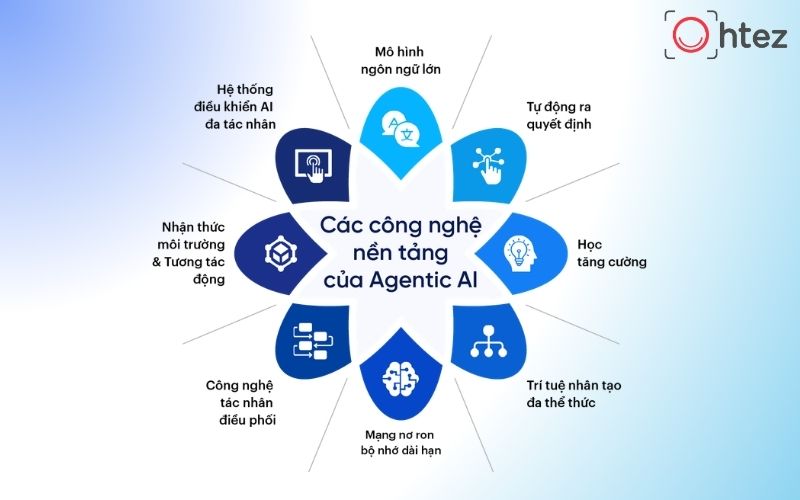
To operate effectively, Agentic AI relies on several coordinated components instead of a single independent AI Agent. This architecture explains why AI Agent and Agentic AI differ in terms of scalability, autonomy, and workflow orchestration.
| Component | Role |
| Orchestrator | Receives the overall goal and coordinates the entire workflow |
| Specialized AI Agents | Complete individual tasks such as data analysis, content creation, or transaction processing |
| Shared Memory | Stores context and shares information among AI Agents |
| Tools and APIs | Connect to CRM, ERP, databases, and external systems |
| Guardrails | Control access permissions, monitor activities, and manage risks |
For example, when processing an order, Agentic AI may coordinate multiple AI Agents to check inventory, verify payment, generate an invoice, and arrange delivery. This architecture enables businesses to implement AI Agent and Agentic AI more effectively, particularly in processes involving multiple steps, departments, and connected systems.
2. How Agentic AI Works
Agentic AI operates through a workflow that can coordinate itself and adapt to changing conditions. This ability is a defining difference between AI Agent and Agentic AI in enterprise environments.
A typical Agentic AI process includes the following stages:
- Receive an overall objective.
- Break the objective into smaller tasks.
- Assign the appropriate AI Agent to each task.
- Consolidate the results and evaluate progress.
- Adjust the plan when data or operating conditions change.
How Agentic AI works
For example, in supply chain optimization, Agentic AI may coordinate several AI Agents simultaneously. One Agent forecasts demand, another checks inventory, and another develops a replenishment plan. When the system detects a market fluctuation, it can update the plan without restarting the entire workflow. This adaptive autonomy is a major characteristic that helps businesses distinguish AI Agent and Agentic AI.
Comparison Between AI Agent and Agentic AI
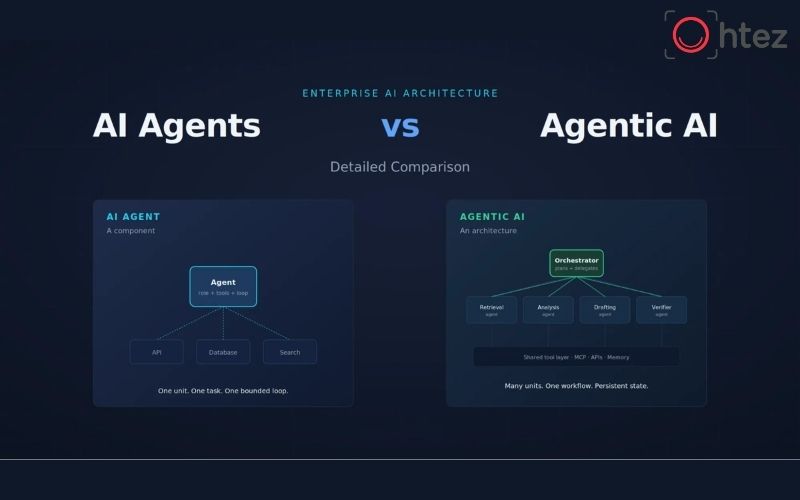
Comparison between AI Agent and Agentic AI
The table below compares AI Agent and Agentic AI based on their objectives, operating models, data requirements, implementation costs, autonomy, and scalability.
| Criteria | AI Agent | Agentic AI |
| Objective | Completes a specific task with a clearly defined output | Receives an overall objective and independently determines the tasks required |
| Processing scope | Focuses on one business function or a related group of tasks | Manages multi-step workflows that may involve several departments |
| Operating model | Receives a request, analyzes data, and performs actions within a defined scope | Breaks down objectives, develops plans, coordinates resources, and evaluates results |
| Planning capability | Uses short and relatively fixed plans focused on individual tasks | Creates multi-step plans that can change when data or operating conditions shift |
| Orchestration mechanism | Connects the tools needed to complete the assigned task | Coordinates multiple agents, tools, systems, and dependent workflows |
| Data sources | Uses one data source or several closely related systems | Commonly connects to CRM, ERP, data warehouses, and multiple business platforms |
| Tools | Uses APIs, software, or databases for a specific business function | Uses a broader tool ecosystem coordinated throughout different workflow stages |
| Memory | Stores context within a task or individual working session | Maintains longer-term context to track decisions and results across the workflow |
| Autonomy | Operates independently within assigned tasks, rules, and permissions | Selects processing steps, assigns agents, and adjusts plans proactively |
| Implementation cost | Low to moderate because of the smaller scope and easier testing process | Moderate to high because it requires multi-layer integration, orchestration, security, and monitoring |
| Complexity | Relatively simple, easier to test, monitor, and control | More complex because it involves multiple agents, systems, and data sources |
| Scalability | Can be expanded by adding separate Agents for independent tasks | Can scale across complete workflows but requires a unified governance architecture |
| Control requirements | Can be managed through rules, activity logs, and approval checkpoints | Requires strict governance of data, permissions, risks, and decision accountability |
| Suitable use cases | Customer service, email classification, data retrieval, and report generation | Sales orchestration, business operations, supply chains, and cross-departmental workflows |
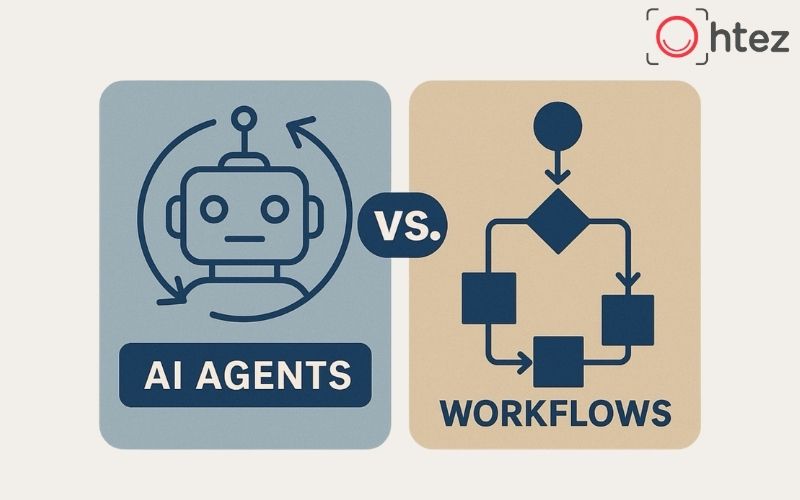
Overall, AI Agent and Agentic AI primarily differ in their scope and orchestration capabilities. An AI Agent focuses on executing a specific task, while Agentic AI combines planning, coordination, and multiple components to manage an entire workflow.
Real-World Applications of AI Agent and Agentic AI
AI Agent and Agentic AI can be applied across many industries, but they address different operational needs. AI Agents are well suited to clear, repeatable tasks, while Agentic AI coordinates multiple activities to achieve a broader objective. When selecting between AI Agent and Agentic AI, businesses should consider their operational scale, workflow complexity, data readiness, and ability to integrate AI with existing systems.
1. AI Agents in Customer Service
AI Agents help businesses automate everyday customer support activities, shorten response times, and improve the overall customer experience.
A customer service AI Agent can:
- Answer frequently asked questions.
- Retrieve order and delivery information.
- Update customer information in a CRM.
- Escalate complex requests to human employees.
This is one of the most common applications of AI Agent and Agentic AI, particularly for businesses that receive a high volume of customer inquiries every day.
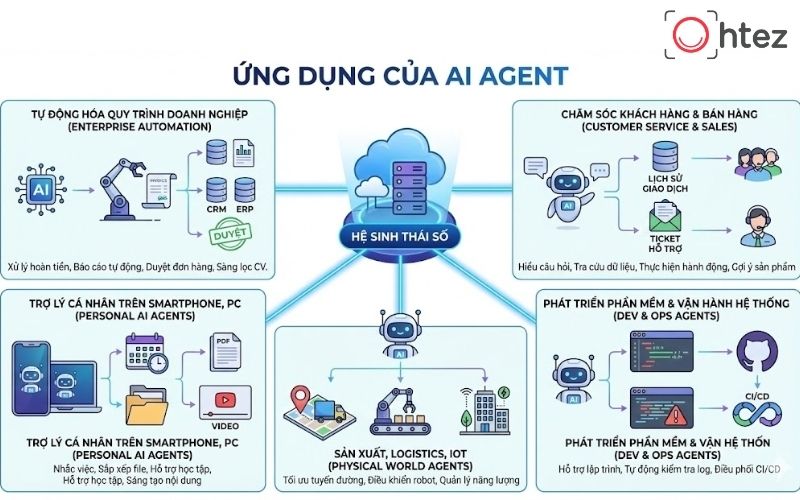
Practical applications of AI Agents
2. Agentic AI in Business Operations
Agentic AI is suitable for multi-step processes involving several departments, systems, and operational dependencies.
The system can:
- Analyze operational data.
- Forecast future demand.
- Recommend an action plan.
- Coordinate multiple AI Agents.
- Monitor and adjust workflows when necessary.
This orchestration capability represents one of the clearest differences between AI Agent and Agentic AI in business operations.
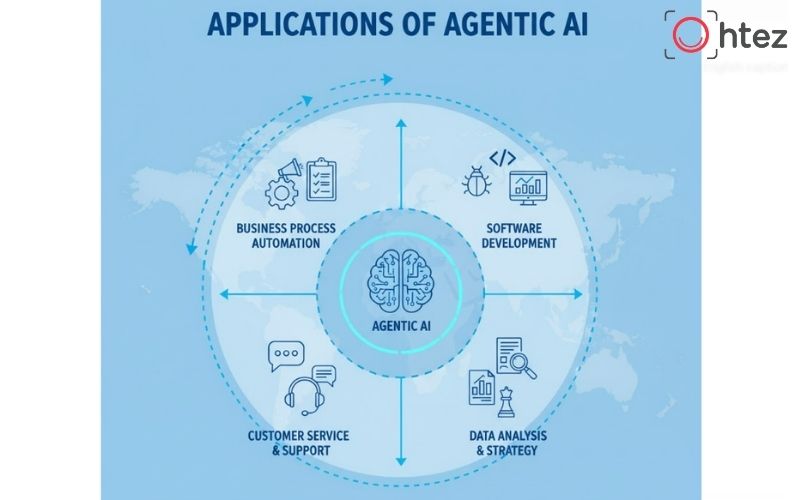
Practical applications of AI Agentic
3. Applications in Marketing and Sales
In marketing and sales, both AI Agent and Agentic AI can improve productivity and decision-making.
- AI Agent: Segments customers, creates content, sends emails, and consolidates performance reports.
- Agentic AI: Conducts market research, develops campaign plans, allocates budgets, and optimizes campaigns in real time.
However, businesses should continue reviewing their content, customer data, and approval processes before allowing AI systems to execute campaigns automatically.
4. Applications in Finance and Supply Chain Management
In finance and supply chain management, AI Agent and Agentic AI can automate many critical business processes.
- AI Agent: Reconciles invoices, verifies documents, and generates financial reports.
- Agentic AI: Forecasts demand, manages inventory, plans transportation, and coordinates payment workflows.
For high-risk processes, businesses should combine AI automation with role-based access, human approval, and monitoring mechanisms to maintain accuracy and security.
When Should a Business Choose an AI Agent or Agentic AI?
Choosing between AI Agent and Agentic AI depends on workflow complexity, the number of systems that need to be connected, and the desired level of automation. When a business only needs to automate a specific task, an AI Agent is often the simpler and more cost-effective option. In contrast, Agentic AI is more suitable for multi-step workflows that require the coordination of several AI Agents and continuous adaptation to new data.
| Criteria | AI Agent | Agentic AI |
| Work scope | A single task or an isolated workflow | A complete multi-step workflow |
| Autonomy | Executes tasks according to an assigned objective | Independently plans, coordinates, and optimizes |
| Suitable for | Customer service, report generation, and data retrieval | Business operations, supply chains, and project management |
| Implementation cost | Lower | Higher because of greater system complexity |
| Scalability | Expanded through individual AI Agents | Expanded by coordinating multiple AI Agents and systems |
Businesses should start with an AI Agent when:
- The task has a clearly defined input and output.
- The process is repetitive and follows predictable rules.
- Only a limited number of systems need to be connected.
- The business wants to test AI automation with a controlled budget.
Agentic AI becomes more appropriate when:
- The objective requires several dependent tasks.
- Multiple departments or systems must work together.
- The workflow needs to adapt when operational data changes.
- The business requires end-to-end process orchestration.
The right choice is not necessarily the most advanced technology. It is the solution that matches the organization’s actual processes, data quality, security requirements, and business objectives.
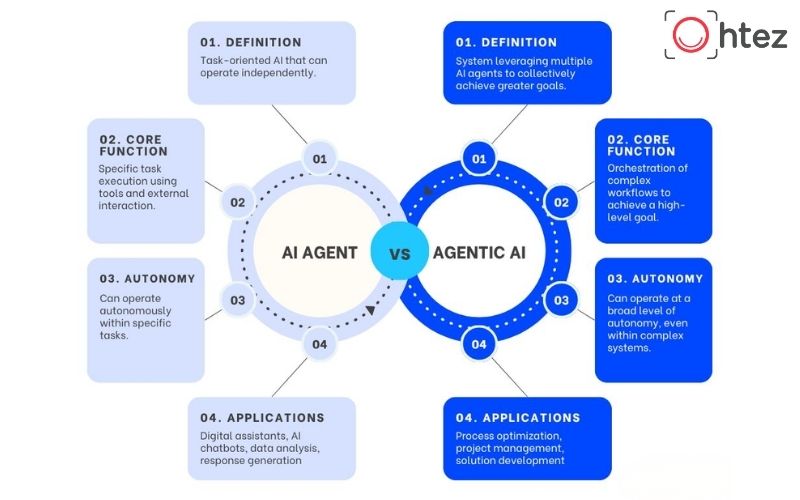
When should you choose an AI Agent and an Agentic AI?
Ohtez AI Agent Development Services
Ohtez provides AI Agent solutions designed around each company’s real operational processes. These solutions help businesses automate repetitive work, optimize workflows, and improve overall productivity. Rather than developing basic chatbots, Ohtez builds AI Agents that can perform business tasks, connect data, and coordinate with the systems a company already uses. This approach also creates a practical foundation for businesses to implement AI Agent and Agentic AI through a scalable, step-by-step roadmap.
Businesses choose Ohtez because we:
- Develop specialized AI Agents for Marketing, Logistics, E-commerce, and many other business functions.
- Design customized solutions based on each company’s workflows, challenges, and operational goals.
- Integrate quickly with popular systems such as Google Sheets, HubSpot, Shopify, Meta, ERP platforms, and other applications through APIs.
- Automate workflows, reduce manual operations, and streamline business processes.
- Support businesses throughout consultation, implementation, employee training, and post-deployment optimization.
- Provide flexible Standard, Pro, and Enterprise implementation packages for medium-sized companies and large organizations.
With an approach focused on measurable operational outcomes, Ohtez helps businesses adopt AI Agent and Agentic AI in a practical way. Companies can start with individual use cases, gradually expand their automation capabilities, improve employee productivity, and reduce operating costs.
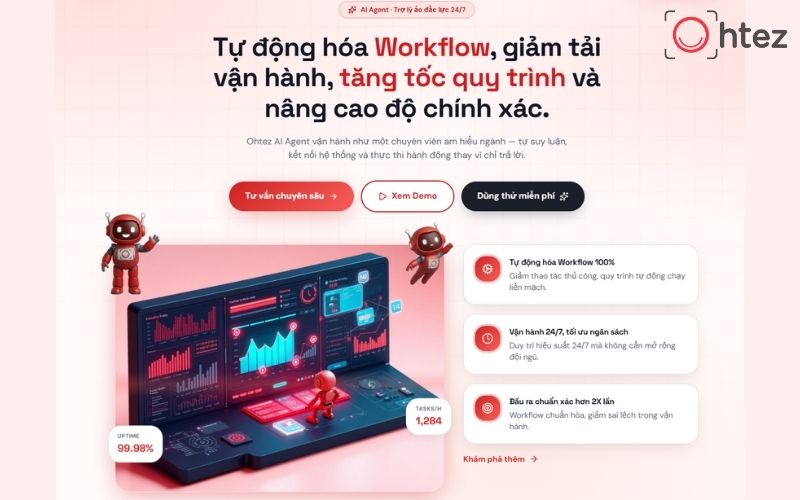
Ohtez’s AI Agent service is reputable and high-quality.
Both AI Agent and Agentic AI deliver significant benefits for business automation, but each model is suited to a different type of challenge. AI Agents optimize individual tasks, while Agentic AI coordinates complete workflows with a higher level of autonomy. Businesses should therefore select their solution based on operational objectives, available data, workflow complexity, and organizational scale rather than simply following a technology trend.
For companies seeking an AI Agent solution tailored to real business requirements, Ohtez provides end-to-end support – from initial consultation and solution design to implementation, training, monitoring, and continuous system optimization.